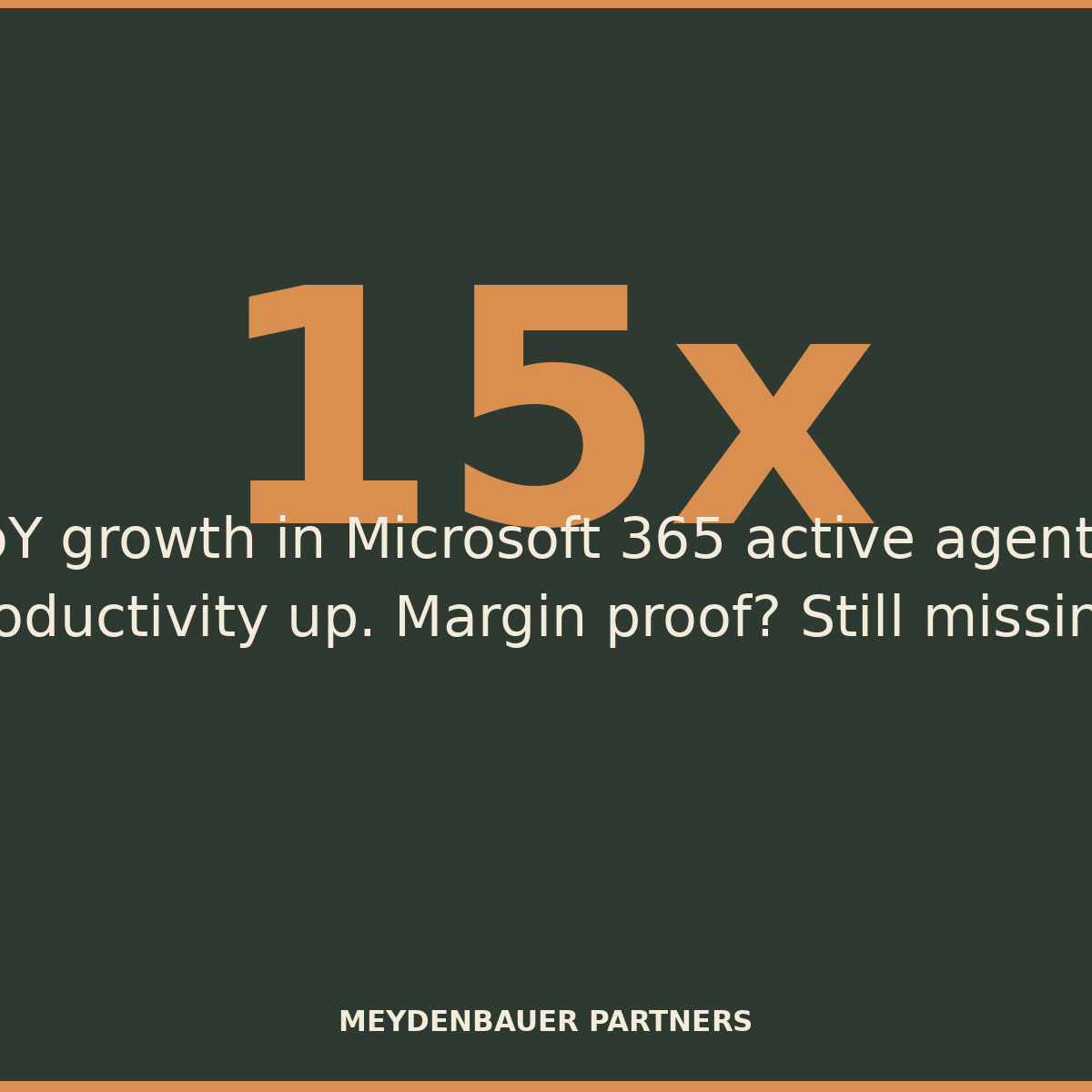
Four days ago, Fortune published Microsoft's latest research on what CFOs actually need to prove AI ROI. The headline finding was buried under the usual productivity metrics: returns depend on whether companies redesign workflows, incentives, and performance metrics around AI-enabled work — not on whether they buy more licenses (Fortune, May 11, 2026). The number of active agents inside Microsoft 365 grew 15-fold year over year, and 18-fold among large enterprises. Yet IDC still expects the active-agent population to hit 1 billion by 2029, while fewer than 10% of enterprises have scaled any agent program to real financial impact (Constellation Research, 2026). That gap is not a model problem. It is an operating-model problem.
The 67% Number Nobody Wants to Underwrite
Only about 29% of executives say they can measure AI ROI confidently, and just 25% of AI initiatives deliver expected returns at all (UC Today, 2026). PwC found organizational factors account for 67% of reported AI impact. Tools account for the remaining third.
What Workflow Redesign Actually Means
1. The handoff contract. McKinsey shows customer service agents resolve a contained ticket for $0.46 versus $4.18 human-handled — a 9x cost reduction, but only if the handoff contract is enforced.
2. The incentive rewrite. If a sales rep's quota assumes 40 outbound touches per day and an agent now delivers 200 qualified signals, the comp plan is broken. PwC found companies with operational foundations were 3x more likely to see real returns.
3. The measurement spine. Median payback is 4.1 months for customer service AI, 6.7 months for marketing operations, 9.3 months for engineering. The measurement spine ties agent activity to a P&L line.
The Operating Model That Actually Ships
Across deployments at growth-stage tech, financial services, and consulting firms in the $5M-$100M range, one pattern repeats. The companies that get to production-grade AI in two quarters: a single executive owns the AI P&L line, every agent has a named human counterpart with rewritten KPIs, and finance builds the measurement spine before the first agent ships. AI arbitrage works when you redesign the work.
Sources: Fortune (May 11, 2026); Constellation Research (2026); UC Today (2026); PwC (2026); McKinsey (2026); IDC (2026).
Cross-site: MBC Partners · TouchpointAI · MBC Capital